U.S. Heraldic Registry
Registration of contemporary and historical American heraldry
About heraldry
The "armorial achievement"
The personal coat of arms, or the "armorial achievement," has several components: the crest, helm, mantling, and shield.
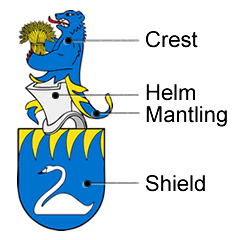
The only only essential component is the shield. Placed above the shield is a helm covered by a cloth, called mantling, which served as protection from the sun. A crest is attached to the top of the helm.
Origins
Heraldry has its origins in marks of affiliation and ownership in the Middle Ages. In early medieval Northern Europe all social classes used pictorial heritable house-marks to identify property. The ancient Celtic clans used colors to indicate social standing and affiliation. Heraldic designs were used on banners and shields during the reign of Charlemagne in the 9th century.
The colorful combination of shield, helm, and crest we are familiar with today emerged around the mid-12th century in Europe, when heralds traveled from town to town to organize military tournaments. Decorated shields, banners and surcoats served to identity soldiers covered in armor. Heralds soon began recording the designs in written form. In the 13th century heraldry spread to the burgher class and by the 14th century to the peasant class. By the 15th century heralds had developed a specialized language in which the visual design could be concisely described or "blazoned." Over several hundred years, heraldry gradually developed into a highly sophisticated art.
Today, heraldry has spread beyond its European origins and can be found in countries around the globe. Heraldic designs are used by sports teams, police, cities, counties, states, federal agencies, the military, schools, churches, and corporations.
Regulation
In some countries, the government authorizes "grants" of heraldic designs to individuals and organizations. Such granting authorities exist in England, Wales, Northern Ireland (The College of Arms), Ireland (The Chief Herald of Ireland), Scotland (The Court of the Lord Lyon), and Canada (The Canadian Heraldic Authority). The rules are strictest in Scotland and England, where it is illegal to freely assume arms.
In the British Commonwealth, the high cost of acquiring a grant of arms has skewed the adoption of heraldry to the wealthiest citizens and has reinforced a perception that heraldry is pretentious. The reverse is true in Continental and Northern Europe where there are few regulations and there is an established tradition of coats of arms used by common citizens, called burgher arms. In Switzerland, for example, it is difficult to find a home, business or farm without a coat of arms. In Germany coats of arms are freely assumed and, if published, receive legal protection.
In most countries, including the USA, one can legally assume any coat of arms one chooses, unless one infringes on a business trademark. However, whether legal or not, it is disrespectful and dishonorable to usurp the coats of arms of others.
Assuming arms
Heraldry is popular in the USA, especially with the growing interest in genealogy. Tracing one's roots to an ancestor who bore arms can be an exciting discovery. It is a common practice to revive the coat of arms used by one's ancestors according to traditional rules of inheritance.
Many people fall victim to swindlers who sell so-called "surname coats of arms." The "bucket shops," which pull a random coat of arms from a bucket, are found selling bogus heraldry in malls, on the internet, and at cultural festivals. These shield-mongers, ignoring the inconvenient concept of inheritance, argue that customers need no relationship to the original owner of a coat of arms; all they need is the same or similar surname. Heraldic societies and registries try to educate the public about these scams.
In most cases, if your father or paternal grandfather did not have a coat of arms, it is best to design your own and to start your own heraldic legacy.
Roll of Arms
Policies